Denver’s Middle Class is Being Locked Out of Denver’s Development

(and they are in the best position to supply affordable housing with long-term development that has the heart and character our city wants)

While young people are continually struggling to find affordable housing in this city, and all ages are disappointed with the beige, short term development that lacks heart and character, with my experience building an ADU, I am eternally confused on why Denver city council is still leaving Denver’s middle class out of the development solution in density rich neighborhoods that welcome it.

For those of you familiar with Cap Hill, it is 75% renters, is made up of grand old stately homes that have been split up into 2-10+ units, or large 20+ unit apartment building that scraped the early beautiful homes during the 50s and 60s.  Our neighborhood, like many neighborhoods immediately surrounding downtown, decided a long time ago to embrace density in favor of a vibrant, walkable, more sustainable lifestyle rather than spread out, car dependent, quiet neighborhoods that are commonly more suburban.  We welcome new neighbors, and hope that with more density we can enjoy higher quality public transit and neighborhood restaurants, bars, and shops.
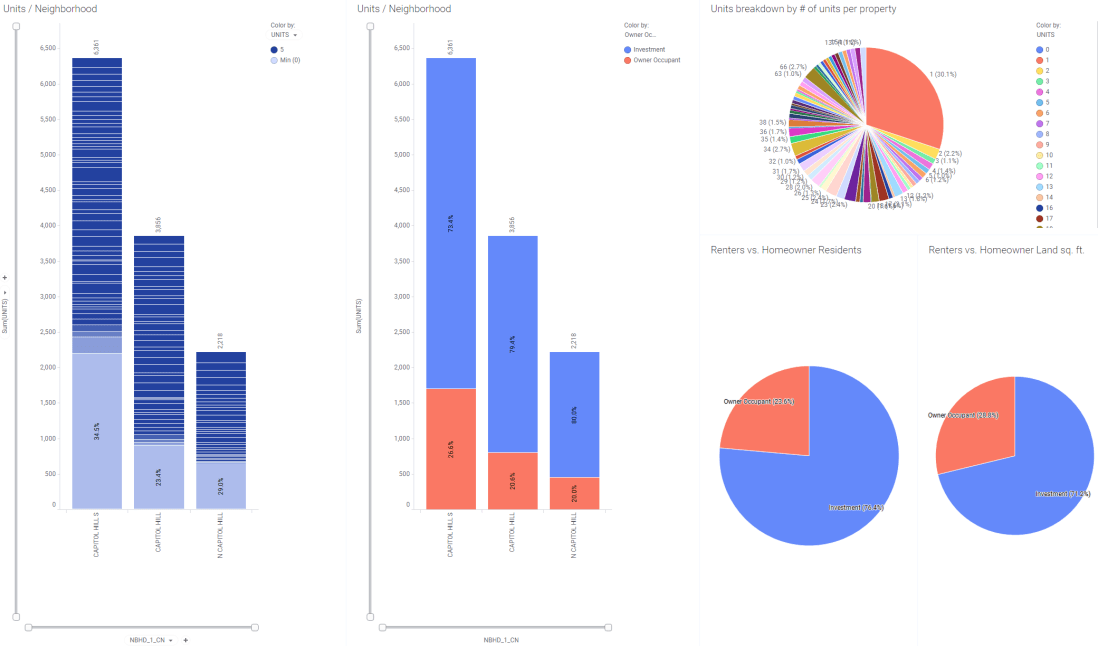
Cap Hill Renter Breakdown
Renter Breakdown of Cap Hill

I would contend that the people best in a position to make thoughtful incremental density, would be a lot like us, your middle class aspiring neighbors willing to owner-occupant and manage duplexes, triplexes, and quads in density seeking neighborhoods who have a long-term vested interest in the success of our city.  The development we would like to do does not change the face of the neighborhood and cannot even be seen from the front street, and there are over 25,000 properties just like ours in density rich neighborhoods adjacent to downtown, yet Denver has continued to bar us from alleviating Denver’s affordable housing crisis and participating in Denver’s housing boom.  
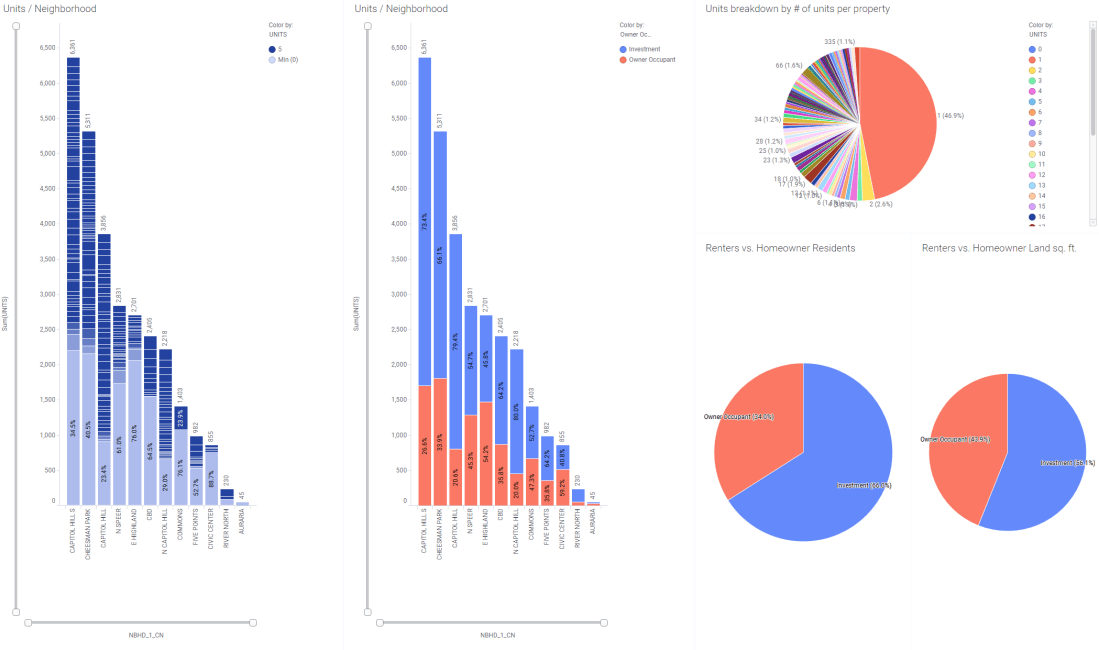
Downtown adjacent neighborhoods Renter Breakdown 2018
Renter Breakdown of neighborhoods adjacent to downtown.

In particular there are 2 types of middle class development that would bring large amounts of quality affordable apartments online while enriching middle class residents who innately have a long term interest in development that has character and heart:

  1. ADUs (Accessory Dwelling Units) – As you probably know ADUs are currently only allowed on single-family building forms.  

This backfires dramatically in density rich neighborhoods such as mine that would love to absorb more density and is already zoned for much more than  2+ units. In our case, while our density rich neighborhood allows as many units as you want up to 5 stories tall, we were not allowed to build a thoughtful ADU behind our beautiful 3 story Denver square that long ago was turned into a triplex and was thus not  allowed to build an ADU despite the 20+ apartment building next door towering over us and having a lot coverage close to 100%

Our only solution was to (at great cost) take the other 2 affordable units we weren’t living (of the triplex) off the market so that we could have a single-family home and thus be legally able to build an ADU in our wonderful dense neighborhood.   

Yes, Denver’s zoning code literally required us to take affordable units off the market in order for middle class owners of a triplex to thoughtfully add development and build an ADU in our lovely, vibrant, density rich neighborhood.

To add insult to injury, I had to take many days off work to argue with the zoning department about setbacks, parking, building coverage, and separation, while large developers could do a new build right next door without having to worry about any of those requirements.  To say the system is slanted towards big developers doing radical ugly change to our neighborhoods is an understatement.

Proposed changes from my experience trying to add a thoughtful ADU embodying character and heart:

  1. a) In Neighborhoods adjacent to downtown that welcome density and already have zoning allowing for duplexes and up,  please please please remove the requirement for ADUs to only be built on single-family homes!


  1. b) For all ADUs please get rid of the non-sensical rule require 15 foot building separation “from the farthest projecting point” of the main house and the ADU.  This rule is super tedious because everyone involved in creating a building (architects, surveyors, plan reviewers) are rightfully oriented towards where building are placed and eaves have always been allowed to extend into setbacks and never been counted in building separation as eaves are super important to architectural beauty as well as great protection from the elements.  Welp, this is not the case with ADU separation from the primary house, it is measured from eave to eave, and because site surveyors don’t even survey eaves, this rule along with Denver’s Building Departments common sense denying review techs required me to take more days off work (that I couldn’t afford) to rent a 24’ ladder and physically measure the eaves of my house, to prove I wasn’t violating a 15’ “farthest extending point” building separation.  This is the only thing in the entire 200 page zoning code that is measured by “the farthest point” mind you. It is dumb, onerous, and promotes people to not put eaves on their houses which is dumb and ugly.


  1. c) Please consider changing the side interior setbacks on ADUs to 3’ everywhere.  Currently, if your lot is greater than 30’ wide your side setback is 5’ and if your lot is less than 30’ wide your side setback is 3’.  My lot was 31’ wide so I could only build a 21’ wide ADU while someone with a 29’ wide lot, can build a 23’ wide ADU. There is just a lot of onerous weird rules that don’t make sense, the best would be if you could just remove as many as possible : )


  1. d) ADUs are currently supposed to be fed by the electrical meter from the main house.  This is extraordinarily dumb and shortsighted as many of the old houses in dense neighborhoods have inadequate electrical services as is, and are struggling to keep up with demands in a modern house (solar panels, appliances, electronics, ect), and new ADUs are perfectly located for new electrical services that can provide power for electric cars, solar panels, and more!


  1. e) For ADUs that would incorporate solar panels, please waive the expensive ($1000/design iteration), and complex energy efficiency evaluation (Manual J&S, and Rescheck) with every iteration of a proposed ADU design.  This is especially ironic to me as an ADU (max 1000 sq. ft. existing rules) on an existing lot close to downtown is inherently orders of magnitude more environmentally friendly than any new build suburban development with the highest efficiency requirements, when you factor in all the infrastructure required for suburban development, not to mention the daily commuting pollution, the environmental advantages of the most inefficient house downtown with solar powered electrical heating is lightyears more efficient than a suburban “energy efficient” home.   Please make a common sense rule allowing a waiver for the efficiency evaluation (Rescheck and Manual J&S requirement) when the ADU will have solar panels as this is a win win for overall efficiency, reducing costly building costs, and simplifying ease for middle class developers. With the 3 or 4 building design iterations it commonly requires to get through the building department. In many cases, middle class developers are already building energy efficient ADUs, they just don’t want to have to pay for an evaluation for each design iteration as well.

1. f)  For ADUs located on gravity fed sewers, please waive the $5000 SUDP permit fee.  You are forcing downtown homeowners with very low cost sewage systems to subsidize expensive pumps for suburban sewage lines.


  1.  Changes in Occupancy requirements in old density seeking neighborhoods such as mine that would love to absorb more density.  In particular, please ease requirements on finishing basements into apartments or dividing large square footage apartments into smaller multiple square footage apartments.

A friend of mine in the highlands recently fell on hard times and decided he would like to rent out his already finished basement (8’ high ceiling and beautiful sandstone walls, existing exterior entrance) in his house that is already zoned for a duplex.  Sounds easy right? Because his 1890 house is 2.8’ from the property line and not the required 3’, he automatically has to apply for a variance and get approval from the board of adjustments right from the beginning. That requires hiring an expensive architect to make a floor plan, untold days off work talking with the building department and neighbors, costly revisions by the architect of the floor plan, to accommodate various small and tedious rules.  This is all before the extensive energy efficiency requirements (having to insulate a stone rubble foundation is ridiculous), and fire-rated ceiling drywall that he would have to put in, and an untold litany of other things for the possibility of still getting denied. Overall, the process is a complete non-starter and he will continue to use the basement bedrooms for the occasional friend or relative. So now that prospective renter that could have very affordably rented his beautiful basement apartment has to go rent a car-dependent much more environmentally resource intensive house far away from downtown, in a neighborhood that is not a natural option for additional density, all in the name of energy efficiency requirement, fire code in a perfectly safe brick/stone house (risk of death or injury from fire is exceptionally low, especially in brick buildings, and especially when electric heating elements are used), and due to zoning requirements for a change of occupancy that in no way changes the exterior of the house : /

Never mind whether he could have filed for a variance and possibly even won.  Having to go through the trouble of applying for a variance, along with all the days taken off of work to meet with the building department, and time spent addressing it and neighbors. is a complete non starter for middle class, working, homeowners and it’s not surprising how little affordable housing apts exist with the ridiculous process involved. Would you really expect a middle class person to go explain to strangers how times are economically tough for them and they would just like permission to rent out his/her basement that is already being used as bedrooms anyway?  I think this is a thoroughly ridiculous expectation that only serves to limit the supply of affordable housing and embarrass and/or make middle class homeowners feel like they are trying to do something that the city frowns upon and intentionally tries to limit. The process is too sophisticated for middle class, working, developers who are in the best position to add thoughtful density to the city, and is a total turn off for your regular working class home owner.

By all means, please require a health and safety inspection to check for egress windows in bedrooms, working kitchen and bathroom, and smoke detectors, but please remove all of the other unnecessary burdens that are too high of a barrier to entry for middle class homeowners that don’t have gaggles of architects, engineers, and lawyers at their disposal.  Another additional downside of the burdensome requirements is that it constantly creates and adversarial relationship with staff at the Denver Building Department who tend to think small unprepared middle class homeowners are trying to “get one over on them”, when all that is really needed is a health and safety inspection and a new address : /.

Proposed changes for change of occupancy requests that do not change the footprint of the house or require additions in preferably in all neighborhoods but especially those in density rich and density seeking neighborhoods close to downtown.

2. a)Eliminate zoning approval for change of occupancy when the footprint or exterior of the house is unchanged in neighborhoods that welcome density that are adjacent to downtown.  Allow for new exterior doors if necessary.

2. b)For change of occupancy requests, please require only a health and safety inspection checking for modern safety and health necessities like:

1.egress windows in bedrooms

2.working shower/bath

3.Working kitchen with sink and ventilated heating element.

4.smoke detectors

2. c)Please do allow homeowners to place another exterior door on the property if necessary without excessive oversight or requirements.

In the end I leave you with Carlson’s law, a common Silicon Valley adage:

In a world where so many people have access to education and cheap tools of innovation, innovation that happens from the bottom up tends to be chaotic but smart. Innovation that happens from the top down tends to be orderly but dumb.

Please implement emergency affordable housing relief and implement these changes in zoning to the benefit of density seeking neighborhoods and middle class developers who are in the best position to create thoughtful affordable density embodying character and heart, while also being allowed to participate in Denver’s booming development.

Leave a comment

Denver’s Middle Class is Being Locked Out of Denver’s Development

(and they are in the best position to supply affordable housing with long-term development that has the heart and character our city wants)

While young people are continually struggling to find affordable housing in this city, and all ages are disappointed with the beige, short term development that lacks heart and character, with my experience building an ADU, I am eternally confused on why Denver city council is still leaving Denver’s middle class out of the development solution in density rich neighborhoods that welcome it.

For those of you familiar with Cap Hill, it is 75% renters, is made up of grand old stately homes that have been split up into 2-10+ units, or large 20+ unit apartment building that scraped the early beautiful homes during the 50s and 60s.  Our neighborhood, like many neighborhoods immediately surrounding downtown, decided a long time ago to embrace density in favor of a vibrant, walkable, more sustainable lifestyle rather than spread out, car dependent, quiet neighborhoods that are commonly more suburban.  We welcome new neighbors, and hope that with more density we can enjoy higher quality public transit and neighborhood restaurants, bars, and shops.

Cap Hill Renter Breakdown
Renter Breakdown of Cap Hill

I would contend that the people best in a position to make thoughtful incremental density, would be a lot like us, your middle class aspiring neighbors willing to owner-occupant and manage duplexes, triplexes, and quads in density seeking neighborhoods who have a long-term vested interest in the success of our city.  The development we would like to do does not change the face of the neighborhood and cannot even be seen from the front street, and there are over 25,000 properties just like ours in density rich neighborhoods adjacent to downtown, yet Denver has continued to bar us from alleviating Denver’s affordable housing crisis and participating in Denver’s housing boom.  

Downtown adjacent neighborhoods Renter Breakdown 2018
Renter Breakdown of neighborhoods adjacent to downtown.

In particular there are 2 types of middle class development that would bring large amounts of quality affordable apartments online while enriching middle class residents who innately have a long term interest in development that has character and heart:

  1. ADUs (Accessory Dwelling Units) – As you probably know ADUs are currently only allowed on single-family building forms.  

This backfires dramatically in density rich neighborhoods such as mine that would love to absorb more density and is already zoned for much more than  2+ units. In our case, while our density rich neighborhood allows as many units as you want up to 5 stories tall, we were not allowed to build a thoughtful ADU behind our beautiful 3 story Denver square that long ago was turned into a triplex and was thus not  allowed to build an ADU despite the 20+ apartment building next door towering over us and having a lot coverage close to 100%

Our only solution was to (at great cost) take the other 2 affordable units we weren’t living (of the triplex) off the market so that we could have a single-family home and thus be legally able to build an ADU in our wonderful dense neighborhood.   

Yes, Denver’s zoning code literally required us to take affordable units off the market in order for middle class owners of a triplex to thoughtfully add development and build an ADU in our lovely, vibrant, density rich neighborhood.

To add insult to injury, I had to take many days off work to argue with the zoning department about setbacks, parking, building coverage, and separation, while large developers could do a new build right next door without having to worry about any of those requirements.  To say the system is slanted towards big developers doing radical ugly change to our neighborhoods is an understatement.

Proposed changes from my experience trying to add a thoughtful ADU embodying character and heart:

  1. a) In Neighborhoods adjacent to downtown that welcome density and already have zoning allowing for duplexes and up,  please please please remove the requirement for ADUs to only be built on single-family homes!


  1. b) For all ADUs please get rid of the non-sensical rule require 15 foot building separation “from the farthest projecting point” of the main house and the ADU.  This rule is super tedious because everyone involved in creating a building (architects, surveyors, plan reviewers) are rightfully oriented towards where building are placed and eaves have always been allowed to extend into setbacks and never been counted in building separation as eaves are super important to architectural beauty as well as great protection from the elements.  Welp, this is not the case with ADU separation from the primary house, it is measured from eave to eave, and because site surveyors don’t even survey eaves, this rule along with Denver’s Building Departments common sense denying review techs required me to take more days off work (that I couldn’t afford) to rent a 24’ ladder and physically measure the eaves of my house, to prove I wasn’t violating a 15’ “farthest extending point” building separation.  This is the only thing in the entire 200 page zoning code that is measured by “the farthest point” mind you. It is dumb, onerous, and promotes people to not put eaves on their houses which is dumb and ugly.


  1. c) Please consider changing the side interior setbacks on ADUs to 3’ everywhere.  Currently, if your lot is greater than 30’ wide your side setback is 5’ and if your lot is less than 30’ wide your side setback is 3’.  My lot was 31’ wide so I could only build a 21’ wide ADU while someone with a 29’ wide lot, can build a 23’ wide ADU. There is just a lot of onerous weird rules that don’t make sense, the best would be if you could just remove as many as possible : )


  1. d) ADUs are currently supposed to be fed by the electrical meter from the main house.  This is extraordinarily dumb and shortsighted as many of the old houses in dense neighborhoods have inadequate electrical services as is, and are struggling to keep up with demands in a modern house (solar panels, appliances, electronics, ect), and new ADUs are perfectly located for new electrical services that can provide power for electric cars, solar panels, and more!


  1. e) For ADUs that would incorporate solar panels, please waive the expensive ($1000/design iteration), and complex energy efficiency evaluation (Manual J&S, and Rescheck) with every iteration of a proposed ADU design.  This is especially ironic to me as an ADU (max 1000 sq. ft. existing rules) on an existing lot close to downtown is inherently orders of magnitude more environmentally friendly than any new build suburban development with the highest efficiency requirements, when you factor in all the infrastructure required for suburban development, not to mention the daily commuting pollution, the environmental advantages of the most inefficient house downtown with solar powered electrical heating is lightyears more efficient than a suburban “energy efficient” home.   Please make a common sense rule allowing a waiver for the efficiency evaluation (Rescheck and Manual J&S requirement) when the ADU will have solar panels as this is a win win for overall efficiency, reducing costly building costs, and simplifying ease for middle class developers. With the 3 or 4 building design iterations it commonly requires to get through the building department. In many cases, middle class developers are already building energy efficient ADUs, they just don’t want to have to pay for an evaluation for each design iteration as well.

1. f)  For ADUs located on gravity fed sewers, please waive the $5000 SUDP permit fee.  You are forcing downtown homeowners with very low cost sewage systems to subsidize expensive pumps for suburban sewage lines.


  1.  Changes in Occupancy requirements in old density seeking neighborhoods such as mine that would love to absorb more density.  In particular, please ease requirements on finishing basements into apartments or dividing large square footage apartments into smaller multiple square footage apartments.

A friend of mine in the highlands recently fell on hard times and decided he would like to rent out his already finished basement (8’ high ceiling and beautiful sandstone walls, existing exterior entrance) in his house that is already zoned for a duplex.  Sounds easy right? Because his 1890 house is 2.8’ from the property line and not the required 3’, he automatically has to apply for a variance and get approval from the board of adjustments right from the beginning. That requires hiring an expensive architect to make a floor plan, untold days off work talking with the building department and neighbors, costly revisions by the architect of the floor plan, to accommodate various small and tedious rules.  This is all before the extensive energy efficiency requirements (having to insulate a stone rubble foundation is ridiculous), and fire-rated ceiling drywall that he would have to put in, and an untold litany of other things for the possibility of still getting denied. Overall, the process is a complete non-starter and he will continue to use the basement bedrooms for the occasional friend or relative. So now that prospective renter that could have very affordably rented his beautiful basement apartment has to go rent a car-dependent much more environmentally resource intensive house far away from downtown, in a neighborhood that is not a natural option for additional density, all in the name of energy efficiency requirement, fire code in a perfectly safe brick/stone house (risk of death or injury from fire is exceptionally low, especially in brick buildings, and especially when electric heating elements are used), and due to zoning requirements for a change of occupancy that in no way changes the exterior of the house : /

Never mind whether he could have filed for a variance and possibly even won.  Having to go through the trouble of applying for a variance, along with all the days taken off of work to meet with the building department, and time spent addressing it and neighbors. is a complete non starter for middle class, working, homeowners and it’s not surprising how little affordable housing apts exist with the ridiculous process involved. Would you really expect a middle class person to go explain to strangers how times are economically tough for them and they would just like permission to rent out his/her basement that is already being used as bedrooms anyway?  I think this is a thoroughly ridiculous expectation that only serves to limit the supply of affordable housing and embarrass and/or make middle class homeowners feel like they are trying to do something that the city frowns upon and intentionally tries to limit. The process is too sophisticated for middle class, working, developers who are in the best position to add thoughtful density to the city, and is a total turn off for your regular working class home owner.

By all means, please require a health and safety inspection to check for egress windows in bedrooms, working kitchen and bathroom, and smoke detectors, but please remove all of the other unnecessary burdens that are too high of a barrier to entry for middle class homeowners that don’t have gaggles of architects, engineers, and lawyers at their disposal.  Another additional downside of the burdensome requirements is that it constantly creates and adversarial relationship with staff at the Denver Building Department who tend to think small unprepared middle class homeowners are trying to “get one over on them”, when all that is really needed is a health and safety inspection and a new address : /.

Proposed changes for change of occupancy requests that do not change the footprint of the house or require additions in preferably in all neighborhoods but especially those in density rich and density seeking neighborhoods close to downtown.

2. a)Eliminate zoning approval for change of occupancy when the footprint or exterior of the house is unchanged in neighborhoods that welcome density that are adjacent to downtown.  Allow for new exterior doors if necessary.

2. b)For change of occupancy requests, please require only a health and safety inspection checking for modern safety and health necessities like:

1.egress windows in bedrooms

2.working shower/bath

3.Working kitchen with sink and ventilated heating element.

4.smoke detectors

2. c)Please do allow homeowners to place another exterior door on the property if necessary without excessive oversight or requirements.

In the end I leave you with Carlson’s law, a common Silicon Valley adage:

In a world where so many people have access to education and cheap tools of innovation, innovation that happens from the bottom up tends to be chaotic but smart. Innovation that happens from the top down tends to be orderly but dumb.

Please implement emergency affordable housing relief and implement these changes in zoning to the benefit of density seeking neighborhoods and middle class developers who are in the best position to create thoughtful affordable density embodying character and heart, while also being allowed to participate in Denver’s booming development.

One thought on “Denver’s Middle Class is Being Locked Out of Denver’s Development

  1. This is such a good post! All of our councilpeople need to read it, along with the council candidates. Have been hoping for new posts in 2019, but I imagine you have bigger things to do. Cheers.

    Like

Leave a comment